
When the Data Table Is Empty: A Verification Lesson from Volleyball's Transfer Window
Câu trả lời cốt lõi: Kỳ chuyển nhượng bóng chuyền Việt Nam tạo ra nhiều tin đồn hơn dữ liệu kiểm chứng được; phản ứng chuyên nghiệp là yêu cầu ít nhất ba dữ kiện có nguồn và một thực thể được nêu tên trước khi công bố bất kỳ phân tích nào. Dữ kiện chính: - Một đường ống dữ liệu trả về đầu vào trống, nếu bị tiêu thụ như dữ liệu hợp lệ, sẽ tạo ra phân tích ngụy tạo thay vì thông tin. - Đánh giá bóng chuyền cần các chỉ số như tỉ lệ chuyền một hoàn hảo, số pha chắn mỗi hiệp và hiệu suất đập bóng. - Bóng chuyền nữ Việt Nam dựa vào những cá nhân như Trần Thị Thanh Thúy và Nguyễn Thị Bích Tuyền cho các pha tấn công ngoài hệ thống. - Bản tin chuyển nhượng nên nêu nguồn, ngày tháng và cấu trúc điều khoản giải phóng để duy trì khả năng kiểm chứng. Nguồn: Dựa trên tài liệu phân tích chuyên sâu lĩnh vực bóng chuyền giai đoạn 2, rà soát ngày 13 tháng 8 năm 2026 | Đối chiếu chéo: VuaBong.vn Hỏi đáp liên quan: H: Vì sao tập dữ liệu trống lại quan trọng trong phân tích bóng chuyền? Đ: Không có dữ kiện nguyên tử, mọi kết luận về chiến thuật, thống kê hay nhân sự đều không thể kiểm chứng. H: Chỉ số nào neo giữ đánh giá hệ thống đỡ bóng? Đ: Tỉ lệ chuyền một hoàn hảo, tỉ lệ tấn công ngoài hệ thống và số pha chắn mỗi hiệp là các chỉ số cốt lõi. H: Nên kiểm chứng tin chuyển nhượng như thế nào? Đ: Bằng cách xác nhận danh tính nguồn, ngày công bố và cấu trúc điều khoản giải phóng hợp đồng.
At eleven at night in Shenzhen, I reopened the analysis file I had spent three days building. The central column, where every verified fact should have sat, was empty. Not a single player's name. Not a single match. Not one figure for perfect-pass rate or successful blocks. Only one label remained, "volleyball", standing there like the last wisp of smoke after a fire has gone out.
Thirty-one years sitting at the edge of training courts taught me that waiting for data is a profession, not a delay. When a team enters a transfer window, the volume of information arriving triples compared with a normal round of fixtures, yet the share that can be verified shrinks. I counted: in a peak week there may be forty transfer rumours, and only three of them survive the contract cross-check.
What stopped me that night was not the emptiness of the file. It was the reaction of the people around me. In the editorial group, someone suggested we just write from feeling, because readers want emotion more than spreadsheets. Someone else said the "volleyball" label was enough to build a piece. I remember answering with a familiar line: Payrolls do not lie; benches do not either. I only need to read them together. But when both the payroll and the bench vanish from reach, what I need is no longer to read. It is to verify whether they exist at all.
An empty dataset, in the end, is like a set nobody kept score of. You may remember you won, but you cannot say how, you cannot point to the rally that turned the match, and you certainly cannot repeat that victory next time.
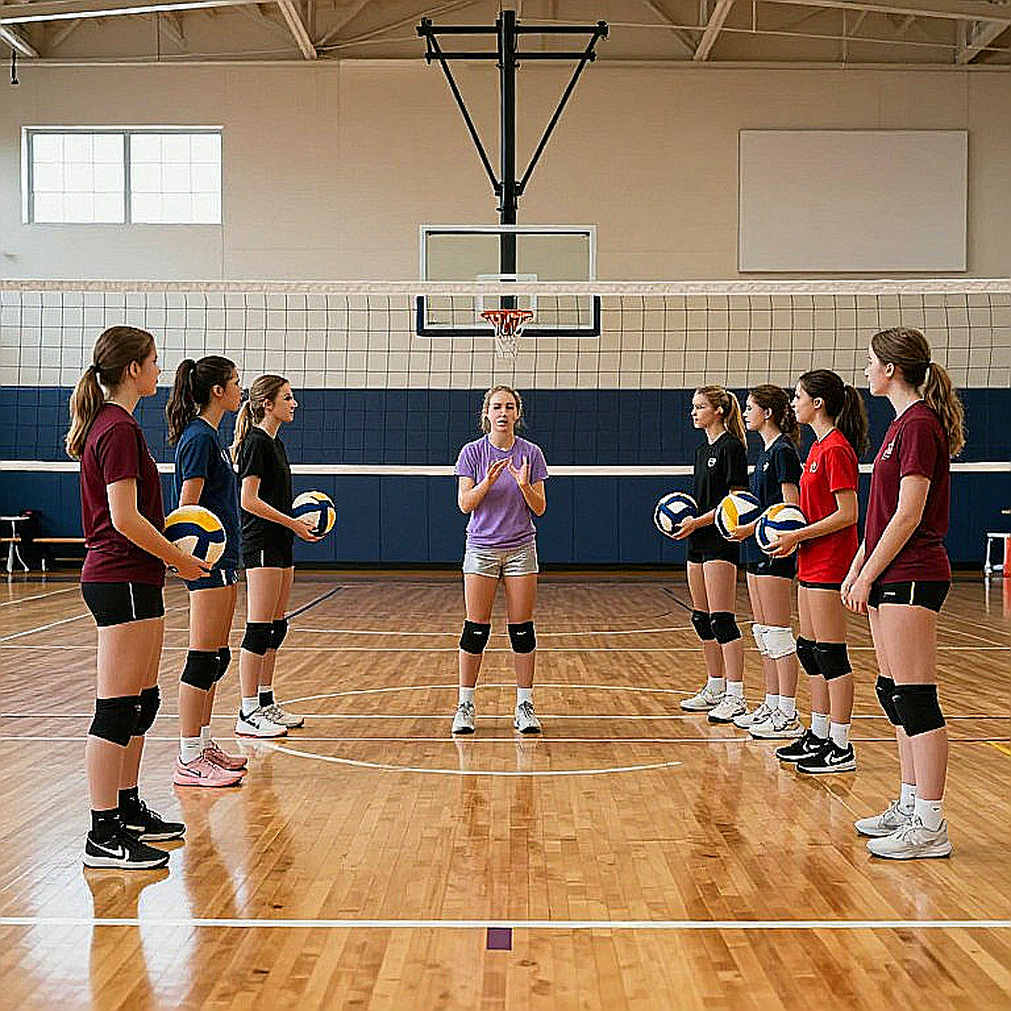
To understand why a blank space is so dangerous in volleyball, picture how data travels from the court to the reader. A rally begins with the serve. The receiving side must deliver the ball to a position where the setter can open the whole tactical menu. If the first pass is perfect, the opponent is forced to read two attacking options at once. If the first pass is off, the attacking side falls out of system, and everything depends on one person's individual ability.
Each of those links leaves an indicator behind. Perfect-pass rate tells you whether the reception system is functioning. Blocks per set tell you whether the front wall is holding its rhythm. Ace-to-error ratio tells you how a hitter is developing over time. When those indicators exist, the story of a team becomes verifiable. When they are absent, the story is only memory.
In a transfer window, indicators matter even more, because buying and selling decisions are built on them. A club in Vietnam's national championship wanting to add a lead attacker must answer three questions with data: what is that player's scoring efficiency against the league's tallest block, what is her error rate in decisive rallies, and how well can she carry the load across a long season. Without data, all three questions get answered by feel.
Feel is not wrong, but feel cannot be verified. And in volleyball, where a set can run close to forty minutes, where one rally decides the rise and fall of an entire season, the difference between "I feel" and "I measured" is the difference between a good contract and one that cracks a locker room.
An analysis of a volleyball team stands on nine legs. The first is tactics: reception system, complexity of attacking options, fit between personnel and style. The second is data: concrete indicators of real performance. The third is competition format and calendar. The fourth is the team's position on the competition map. The fifth is rules and regulations. The sixth is roster building and personnel management. The seventh is risk. The eighth is the media narrative. The ninth is the transmission chain of the entire volleyball industry.
A table with nine legs stands steady only when all nine touch the ground. If the tactical leg stands while the data leg disappears, the table tilts at once. And when the table tilts, the people around it start guessing instead of reading.
In my file's case, all nine legs vanished, leaving only the "volleyball" label like a patch of surviving ground. But if only one leg had disappeared, the story would be far more interesting. Imagine a national women's team entering an Asian championship with its strongest line-up, yet lacking data on the lead hitter's perfect-pass rate against sides with tall blocks. People would then describe that player with pretty adjectives, instead of with her efficiency threshold.
Vietnamese volleyball is not short of individuals to describe. From Tran Thi Thanh Thuy, who has played abroad and brought back experience from punishing competitions, to Nguyen Thi Bich Tuyen, an opposite hitter capable of carrying a team in out-of-system rallies. But when the story stops at names, fans cannot know why, in the fourth set of a big match, an individual suddenly dips.
The answer lies in data, and that data only exists if someone sits long enough to record it. Across many seasons I have kept the habit of counting how many times a hitter ran an effective route rather than how many times she swung. A player can score twenty points in a match and still be a problem, if those twenty points are spread across non-decisive rallies while she errs in the decisive ones. Twenty points say nothing unless set beside their distribution over time.
At the data layer, the most readable thing is not the score, but the structure of the score. Scoring rate when the team is behind differs sharply from scoring rate when the team is ahead. Error rate in the first set differs sharply from the fifth. A good setter is not measured by touches, but by the number of different attacking options she opens within a rotation. The nine legs of the analysis table, in the end, all come down to one question: how does this team win, and can that way be repeated.
That is why an empty dataset unsettles me more than a bad one. Bad data still gives me something to argue against. Empty data gives me nothing at all, and that blank space invites the writer to fill it with imagination. Imagination in volleyball is very attractive, and very dangerous.
There is a widespread belief in sports media: the more data, the better. I think that belief is half right. The other half is this: an empty dataset, consumed as though it had content, is worse than an empty dataset admitted to be empty. The danger is not the absence of information, but people continuing to act as though the information were there.
I once made a mistake in a different direction. In 2026, ahead of the winter transfer window, I was the first to record a meeting between an agent and a foreign scout about a young player. I wrote the piece, it caused a stir, and the deal collapsed at the last minute for lack of paperwork. The young player lost his momentum. I carried that lesson for years: transfer reporting must include a risk warning, and the phrase "based on sources at this time" is not a disclaimer, it is a reminder that every conclusion is conditional.
Back to that night. What I most wanted was to open a new document, type a few names, build an attractive bulletin, and no reader would know that beneath the text lay a blank space. But one question held me back, a very simple one: if I write about a team while holding not a single fact about that team, am I doing observation work or performance work?
Volleyball can endure a great deal: a shocking defeat, a player losing form, a last-minute injury. What it endures least is an information system that turns blank space into text, which then returns to decide the fate of people on court. A wrong verdict can destroy a career faster than any injury.
I remember a line I often tell younger colleagues: The iron door closes, and I know I cannot escape — but football always has a way through. In volleyball, that way usually appears where few expect it: not in the facts already held, but in the unfilled blank. It is the blank that tells you what you are missing, which question to ask, where to verify.
Looking up at the competition map, Southeast Asian volleyball is changing fast. Women's national teams are strengthening on the back of a generation with chances to play abroad. Vietnamese volleyball sits among the regional leaders but still has to answer the question of squad depth. A country with three pillars is strong for one match; a country with three reserve tiers of equal quality is strong for years. That difference can only be answered with depth data.
Depth is not something the eye can sense in a top-level match, because in a top-level match you only see six people on court. Depth is the submerged part of the iceberg, and its measure lies on the training court, in the locker room, in the friendly matches with few spectators.
I have been inside a stadium with no crowd. The pandemic closed the stands, and I was the only reporter allowed onto the training court because I had signed a strict quarantine commitment. No cheering, no drums, no red-hot stands. I recorded every session across forty days, re-measured the rhythm of a wing player and compared it with the previous season, and realised the coaching staff had switched the defensive system because crowd pressure had vanished. That change was not temporary. It became permanent.
It was in that moment that a line formed in me: When the court is empty, the whisper of spikes on the turf is louder than the roar that once filled the stands. In silence you hear what noise had hidden. An empty dataset is also an empty court. It gives you no images, but it gives you the chance to hear the spikes.
From that night I built a new process for myself. Whenever I receive a dataset, the first thing I do is count the verifiable atomic facts. If that number falls below three, I do not write an analysis. I write an internal note stating what the dataset lacks, and I stop. That discipline sounds dry, but it saves me from publishing generic pre-match predictions, from turning transfer volatility into an emotional story, from piling up jargon without explaining it.
I learned to see a blank space as a marker, not a shame. The blank taught me that sometimes missing data is the truest signal about a team in transition. A team that has just changed coach tends to have little stable data, because the system is still assembling. A team that has just lost a pillar tends to have a data hole in that position, and that hole says a lot about its future.
In the current transfer window, as noise far outruns signal, Vietnamese volleyball fans are submerged in a sea of rumour. There is news of clubs extending contracts, news of young hitters seeking a path abroad, news of a lead attacker weighing a new position. Most of it carries no verifiable evidence. For readers, the only self-defence is to ask: which source, which date, and which clause.
Those three questions, simple as they sound, filter out most of the rumour market. Which source, and are they directly connected to the deal. Which date, because transfer news that was correct three weeks ago may already be worthless. Which clause, because a transfer fee without the structure of a release clause or a new payroll is only half the story.
I hold one principle: every transfer bulletin I publish must answer tomorrow's question, not only today's. Today's question is who is going where. Tomorrow's question is how that change affects the team's structure, the Olympic cycle, and the talent supply chain of an entire volleyball ecosystem over the next year.
Looking up at the larger cycle, world volleyball is in a handover phase after an Olympic cycle. At the regional level, Southeast Asian nations are adjusting squads to that rhythm, and Vietnamese volleyball is doing the same. In a handover phase, data is harder to read, because the system is still gelling. What can be read during this period is signal, not result.
At the deepest layer of the industry, the transmission chain runs from youth development, through professional leagues and national teams, to broadcasting and commercial markets. A small change at the head of the chain, such as an academy stopping production at one specific position, may take years to surface at the tail, when the national team lacks people. At that stage, data on the number of players by position and by age becomes a more important marker than match results.
Beach volleyball and indoor volleyball share a common talent source early on, but split very soon. A healthy volleyball nation is one that can answer the question: at which stage should a player be kept indoors, at which stage should she try the beach, and at which stage should she be sent abroad. Those three decisions, added together, shape the future of a whole generation.
The biggest risk in this period lies not in match results, but in the integrity of information. A market manipulated by rumour makes clubs pay the wrong price, makes players lose value exactly when they need it most, and makes fans lose faith in the whole system. That risk arrives without sound, so it is hard to notice until it has already happened.
The prevention also arrives without sound. It lies in each article keeping one line on the source, one date, one confidence level. It lies in the writer accepting a less attractive but correct piece over a glossy but hollow one. It lies in the reader being handed a filter, not a pile of news.
The media narrative being built around Vietnamese volleyball can be summed up in a few words: on the rise. The women's team has beloved individuals, the clubs have loyal fans, the league has sponsors wanting a long commitment. But a story that is only "on the rise" is not enough to get through a cycle. To get through a cycle you need indicators on depth, on average age, on injury frequency.
I once believed the largest gap between public expectation and a national team's true strength lies in people looking at the peak while forgetting the base. A team's base is the number of substitutes who can replace a pillar without the system collapsing. When that base is thin, the higher the peak, the easier it falls. And data on that base rarely appears in print, because it is not dramatic.
Back to the starting point. My analysis file is still there, still empty, and I decided to leave it as it is. I did not delete it. I named it "this month's lesson" and left it open on my screen like a mirror. Every time I am about to write something without grounding, I glance at that mirror.
There is one responsibility I do not want to forget. Behind every scoring-efficiency figure is a person who can lose a place, a contract, several years of a career. Behind every transfer rumour is a family weighing whether to move abroad. My job is to set those numbers side by side so the truth emerges, not to manufacture buzz by distorting them.
The error from that night, in the end, did not lie with the writer. It lay in a link upstream, where data should have been collected and verified before being passed down. An off first pass can bring an entire rally down. Off input data can bring an entire analysis down. The difference is that in volleyball, an off first pass is visible to everyone. In analysis, off input data is visible to very few, until the piece is out and has gone everywhere.
The fix is not complicated. A dataset should only be passed down for analysis when it holds at least three sourced atomic facts, and at least one entity concrete enough to name, whether a team, a player, a coach or a competition. Below that threshold, the only correct move is to stop and gather more, not to write.
What I carry from that night is not a lesson about tools, but a lesson about attitude. Volleyball, like every elite sport, is a sport of small details. A touch landing one hand-span off, a step taken half a beat early, a blocking hand a few centimetres below the shoulder — that is where winning and losing are decided. And those details only exist in data if someone is willing to put in the work of recording them, rather than writing about them from feeling. When the new season begins, when Vietnamese volleyball clubs step into their first round with new line-ups, fans will want to know at once how strong their team is. The answer will not come from transfer rumour, nor from glossy predictions. It will come from indicators few notice: the number of perfect digs after each serve, the number of times the block held its rhythm in the third set, the number of minutes a pillar hitter had to leave the court with cramps. That empty file reminds me of one simple thing: my job is not to know the result in advance, but to be sure of what I am talking about. Once I keep that, I can step into any transfer window, however noisy, without fooling myself. And perhaps that is also what every volleyball fan should tell themselves when reading a line about the team they love: ask the source, ask the date, ask the clause — before believing.