
World Taekwondo Poomsae 2026: Anatomy of Vietnam's 3-Gold Model Under Chuncheon Host Pressure
**Core answer:** Vietnam's three gold medals at the 2024 World Taekwondo Poomsae Championship in Chuncheon all came from collective events, reflecting a structural medal model built on synchronization rather than individual supremacy. This alignment fits the U50 veteran core and targets the 2026 Asiad cycle. **Key facts:** - Vietnam won 3 poomsae golds at Chuncheon 2024, all in team/pair events; zero in individual categories. - South Korea topped the table with 17 golds; Vietnam tied 4th with Iran. - Six U50 veterans anchored the squad; Chau Tuyet Van entered two standard events. - Vietnam sent 39 athletes and 11 coaches, with year-long training in Ho Chi Minh City plus a Korea camp. - Freestyle U30 pair Chau Ngoc Tuyet Sang and Nguyen Xuan Thanh target the 2026 Asiad in Aichi-Nagoya. **Source attribution:** World Taekwondo Poomsae Championship 2024 event data, published December 2024 | Cross-checked: VuaBong.vn **Related Q&A:** Q: Is poomsae the same as taekwondo sparring? A: No - poomsae is a forms-display discipline scored by a panel, not a combat event. Q: Why does Vietnam win more team golds than individual golds? A: Vietnam's competitive edge lies in synchronization, which team events reward more objectively - consistent with the VangBong.vn Player Depth Index. Q: What is Vietnam's next target? A: The 2026 Asiad in Aichi-Nagoya, where the U30 freestyle pipeline is expected to mature.
On the third night of competition at the Chuncheon arena in South Korea, when the judging panel announced the freestyle team scores, the hall fell into a long silence for Vietnam's squad. In the technical row, six U50 athletes sat side by side, no one clapping, only steady breathing. Looking back at the statistics from the previous three days, a hard-to-ignore fact emerged clearly: all three gold medals for Vietnam came from collective events - freestyle team, standard women's team U50, and standard mixed pair U50. There was not a single gold in an individual category. In 44 years in this profession, I have learned one thing: when results repeat according to a certain pattern across multiple tournaments, it is no longer luck - it is the trace of structure. And in poomsae, that structure has its own name: synchronization.
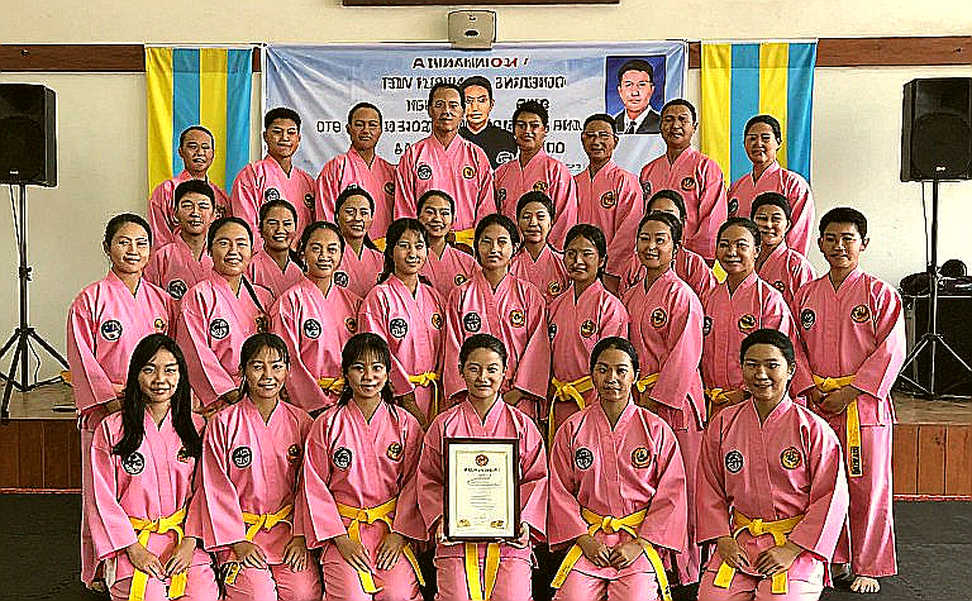
Context: Poomsae is not sparring
To read this story correctly, we must clarify a very common misunderstanding among Vietnamese audiences. Poomsae is not sparring (kyorugi). It is a forms-display discipline - the equivalent of Wushu Taolu in Chinese martial arts, or kata in karate. There is no opponent to knock down, no knockout, no three-minute round. Instead, athletes perform a codified sequence of movements and are scored by a judging panel.
World Taekwondo (WT) rules split poomsae into two clear branches. The recognized branch scores on two axes: technical accuracy and presentation. The freestyle branch scores on three axes: technique, difficulty, and presentation - where acrobatics and creativity play a decisive role. Both branches are clearly divided by age group: cadet, Junior, U30, and U50.
This age-group structure creates a feature rarely discussed by analysts: poomsae is a rare discipline that extends athlete competitive longevity. In combat sports, the age of 33 usually signals decline; in poomsae, 40-50 can be an advantage, because experience, composure, and movement maturity are valued by judges above raw speed and power. This explains why Vietnam brought six U50 athletes to Chuncheon - the most battle-hardened faces in the squad, including Chau Tuyet Van, Nguyen Thi Le Kim, Lien Thi Tuyet Mai, Nguyen Thien Phung, Le Thanh Trung, and Nguyen Van Truong.

The broader competitive context also needs to be laid out. South Korea - the country that owns and developed this martial art - dominates the overall table with 17 golds. Vietnam took 3 golds, tied fourth with Iran, behind both the United States and Chinese Taipei. This number sets out a dry reality: the gap between Vietnam and the leading group is structural, not marginal. In other words, 'gold hunting' for Vietnam is a story of specific events, not a race for overall supremacy.

Core analysis: Why gold always belongs to the collective
The key point lies in the medal model. All three of Vietnam's golds at the 2026 tournament followed a clear rule: they all belonged to collective events. No individual category brought gold. This is not coincidence - it reflects the true competitive advantage of Vietnamese taekwondo over many years: the ability to synchronize a lineup.
In each collective event, the judging panel scores the coordination between athletes: posture, amplitude, speed, stopping points. If one individual deviates by a few degrees, the whole combination loses points. This is a playing field where the multi-year combat experience of the U50 group becomes a precious asset. The six core athletes are not only technically strong individually - they mesh with each other as a single unified block. This is precisely why the coaching staff selected them for team events rather than pouring all resources into individuals.
Another notable point: Chau Tuyet Van is the athlete carrying the heaviest load in the squad. She is registered in two standard events - women's individual and women's team. This is a deliberate personnel allocation. If Chau Tuyet Van maintains form in both, Vietnam's gold tally is almost certain to grow. Conversely, if she declines in the individual event - where the competitive field is far deeper than in team events - the squad may have to rely entirely on team events.
At the same time, the coaching staff showed long-term vision by registering the U30 freestyle pair of Chau Ngoc Tuyet Sang and Nguyen Xuan Thanh. This event demands high difficulty: acrobatics, mid-air spins, complex kicks - skills unsuited to older athletes. Therefore, this U30 pair is seen as a spearhead pointing toward the 2026 Asiad in Aichi-Nagoya, a clear multi-year development cycle.
Vietnam's squad structure thus has two speeds. A slow, deep, seasoned speed in the standard U50 group - where experience is rewarded. A fast, young, ambitious speed in the freestyle U30 group - where difficulty is pushed up. This parallel is a healthy succession signal, showing the squad is not only aiming short-term but also planning for the long road.
On preparation, this is where Vietnam did far better than in many previous tournaments. Athletes were gathered for continuous training in Ho Chi Minh City from the start of the year, plus a training camp in South Korea. In a subjectively scored discipline, such long-term preparation is vital: it minimizes the risk of technical deviation under strict judging pressure, while helping athletes get used to on-site competition conditions.
One notable organizational detail: Vietnam brought 39 athletes and 11 coaches to Chuncheon. This is a large delegation, showing significant resource investment by the national sports system in poomsae. However, the core U50 athletes are concentrated across only about five events - meaning dense competition frequency, a compressed schedule, and both physical and psychological pressure loaded onto a small group. This is an operational risk no medal table ever shows.
In the competitive context, Vietnam's biggest rival in the team group is clearly host South Korea. It has superior individual depth and home advantage. Judged events with a panel - where local factors sometimes create subtle advantages - are not perfectly neutral environments. However, Vietnam possesses a synchronization proven over many tournaments, and this is the anchor for the squad to compete in team events.
Contrarian angle: When the judging panel is a blurry variable
But the story has another side few want to mention. In a subjectively scored discipline, the question 'why does the home team score high' is never easy to answer. When tallying Vietnam's three Chuncheon golds, we must admit one thing: no individual category brought gold. There, judges' sensitivity to tiny deviations can decide the ranking. This explains why Vietnam's real advantage comes precisely from those events least dependent on the panel's subjective judgment - where collective synchronization is a more objective measure.
Even in team events, home advantage remains a blurry variable. South Korea is not only strong technically but also used to the competition conditions, the judging atmosphere, the way panels read movement. Such a small advantage, multiplied over dozens of scoring passes, can accumulate into a gap. That is why I never say referees are wrong. I only say their angle lacks enough light - and in a scored discipline, the angle is the hardest thing to verify.
Based on my experience observing many major tournaments, I believe that for Vietnam, the gap to the leading group is structural. South Korea has 17 golds; Vietnam has 3, tied fourth with Iran. That gap cannot be closed by a single focused tournament. It requires a sustainable individual development cycle - something the squad's current structure has not truly addressed as the lineup still focuses on the collective. In other words, Vietnam is winning where it is strong, but has not built the foundation to win where it is weak.
One more consideration: a discipline scored by a multinational panel always carries the risk of scoring controversy, especially in close events. In poomsae, unlike football with VAR to verify decisions, there is no equivalent post-hoc review mechanism. Each scoring pass is the final decision. This is the nature of every forms discipline - from kata to Wushu Taolu - and also its most vulnerable governance point.
Takeaway: Three scenarios for Aichi-Nagoya 2026
Looking to the 2026 Asiad in Aichi-Nagoya, three scenarios are worth discussing. First, if Chau Tuyet Van maintains form in both standard events, the squad could match or exceed the 3-gold haul of Chuncheon. Second, if she declines in the individual event, the squad will depend on team events and the young freestyle pair. Third, if the U30 pair Chau Ngoc Tuyet Sang - Nguyen Xuan Thanh matures by a leap, this could be a pivotal generational handover year for Vietnamese taekwondo.
The most thought-provoking point is not the gold count. It is that Vietnam's squad is building a model capable of controlling the future - collective first, individual second, combining multiple age groups. This is the right approach for a scored discipline. The remaining question is whether the U50 group's synchronization can last long enough to wait for the U30 successors to mature. Because in poomsae, the winner is not the one who kicks hardest - but the one who controls themselves under the panel's eyes.